
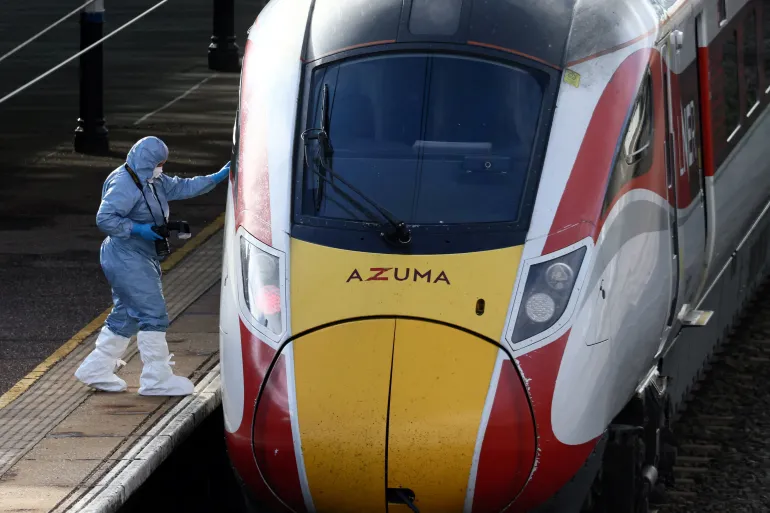
A routine Saturday train ride turned into one of the most harrowing public transport incidents in recent British memory. On the evening of November 1, 2025, a passenger aboard a train traveling from Doncaster to London King’s Cross unleashed a violent knife attack, injuring over a dozen people and leaving a nation in shock.
The stabbing occurred shortly after the train left Peterborough, as passengers settled into their seats for what should have been a peaceful journey. Within minutes, panic erupted inside the carriage — screams, cries for help, and the frantic rush of passengers trying to escape the chaos.
A Heroic Intervention Amid Panic
As the attacker moved through the aisle brandishing a large knife, several passengers tried to shield others from harm. Among them was a railway staff member who bravely stepped forward to stop the assailant. He sustained critical injuries but is credited with preventing even greater bloodshed. Authorities later described his actions as heroic and emblematic of the courage often displayed by ordinary people in moments of unimaginable terror.
The Suspect and Police Response
The man identified by police as the 32-year-old Anthony Williams from Peterborough was swiftly arrested when the train made an emergency stop at Huntingdon Station, roughly 75 miles north of London.
Armed officers boarded the train within minutes of the emergency call, detaining the suspect without further injuries.
Authorities confirmed that the incident was not linked to terrorism, emphasizing that it appeared to be a criminal act by a lone individual. A second passenger who was initially questioned was later released without charge.
In the aftermath, police praised passengers for their cooperation and composure under pressure. Many had taken refuge in restrooms or shielded others, helping emergency responders locate the injured when the train was stopped.
Witness Accounts: Fear, Confusion, and Bravery
Survivors described scenes of panic and confusion. Some passengers thought they were experiencing a robbery; others initially mistook the commotion for a fight. But when the screams grew louder, it became clear that something far more dangerous was unfolding.
“I saw blood on the floor and people running,” one witness recounted. “A man yelled, urging everyone to get down for safety.Someone was trying to hold the attacker back — it was chaos.”
Others described helping the wounded with makeshift bandages made from scarves and shirts, comforting crying children, and coordinating with police through emergency phone calls.
The Broader Picture: Knife Crime in the UK
While the immediate horror of the attack is unique, it fits within a troubling national trend. Over the past decade, knife-related offences in England and Wales have risen sharply, driven by social inequality, gang culture, and mental health crises.
The UK government has launched multiple initiatives to combat the issue — from increased stop-and-search powers to youth outreach programs — but experts say the problem is deeply rooted.
Cuts to community services, economic stress, and the isolation brought on by modern urban life all contribute to an environment where violence can erupt suddenly and unpredictably.
In this case, investigators are still working to determine the suspect’s motive, background, and mental health condition. Early reports suggest that the attack was not premeditated in connection with any group or ideology.
Security and Public Trust on Trial
The incident has reignited public debate over security on British trains, especially as millions of people rely on long-distance rail travel every week.
While the UK’s transport system has strong safety measures in place, critics argue that unarmed staff and lack of routine passenger screening leave certain vulnerabilities.
However, law enforcement officials warn that expanding airport-style security to trains could create logistical nightmares. Instead, they emphasize faster emergency response systems, staff training, and community awareness as more practical steps.
For the public, the emotional scars of such an event linger far longer than the physical injuries. Many passengers on that ill-fated train have spoken of nightmares, anxiety, and fear of traveling again — stark reminders of how random violence can alter ordinary lives.
Heroism, Humanity, and Hope
Amid the tragedy, stories of bravery emerged — passengers helping strangers, medical workers rushing to the scene, and ordinary citizens stepping into danger. The injured train worker, in particular, has become a symbol of resilience and duty. His colleagues described him as “calm under pressure” and “someone who always put others first.”
The outpouring of public support — from candlelight vigils to messages on social media — reflects a shared determination not to let fear dominate public spaces.
Lessons and the Road Ahead
The UK train stabbing incident underscores the fragile balance between personal safety and public freedom in modern society. It reveals how quickly violence can disrupt daily life, but also how communities respond — not with despair, but with solidarity and courage.
Authorities have pledged to conduct a full review of rail security and emergency communication systems. Mental health experts have also urged increased investment in early intervention programs to identify individuals at risk of violent behavior before such incidents occur.
Conclusion
The train stabbing in England serves as both a chilling reminder of the dangers of unchecked violence and a testament to the resilience of ordinary people. In a moment of chaos, strangers protected strangers; fear met courage; and tragedy sparked conversations about how a nation can stay safe without losing its sense of openness.
The tracks between Doncaster and London will soon carry thousands more journeys — commuters, families, and travelers returning to routine. Yet for those who lived through that night, the echoes of what happened will never completely fade. And for the rest of us, it’s a call to strengthen not just our security, but our shared humanity.