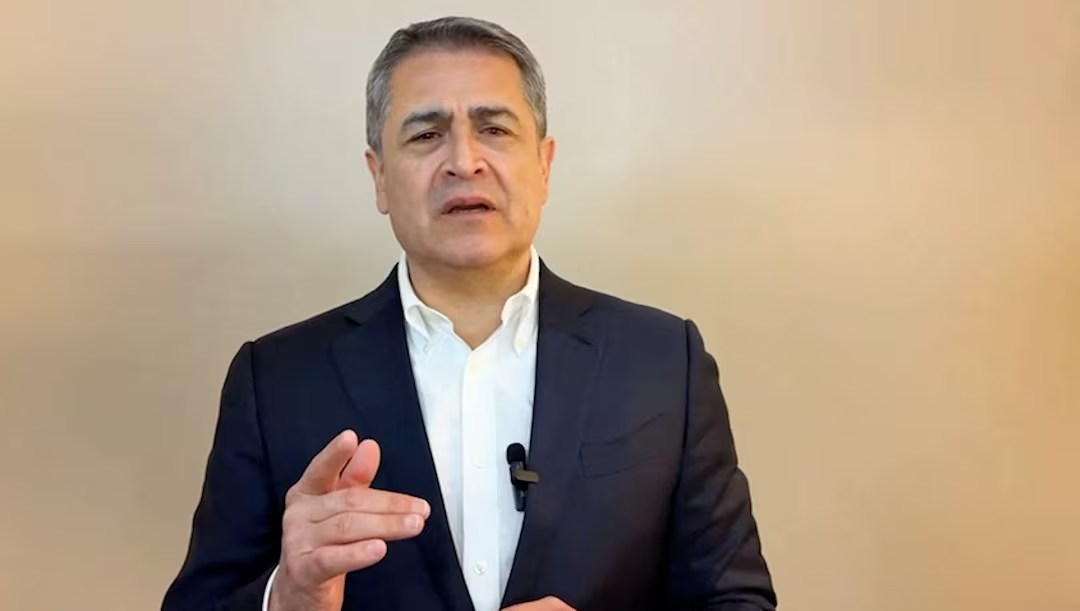
The issuance of an international arrest warrant for former Honduran President Juan Orlando Hernández marks a major turning point in both Honduras’s internal political climate and its broader relationship with international law enforcement agencies. This development comes at a particularly sensitive moment, only days after Hernández was released from a United States prison following a presidential pardon. While the U.S. pardon secured his freedom from an American conviction, it did not shield him from legal accountability in his home country. Honduras’s decision to reactivate domestic charges and pursue an international warrant underscores the country’s intention to demonstrate that no individual, regardless of former political power, is beyond the reach of the law.
Background: From High Office to Criminal Accusations
Juan Orlando Hernández once stood as a central figure in Honduran politics, holding the presidency for two consecutive terms from 2014 to 2022. His tenure was often characterized by promises of economic reforms and commitments to counter drug trafficking. However, behind this public image, allegations mounted over the years suggesting that Hernández had engaged in illicit activities and facilitated drug operations during his administration.
After leaving office, Hernández was extradited to the United States, where federal prosecutors accused him of participating in a large-scale conspiracy to traffic cocaine into the country. Prosecutors argued that he used his presidential authority to shield powerful drug traffickers and that he accepted substantial monetary benefits in exchange for political protection. These charges culminated in a federal trial where he was convicted and subsequently sentenced to a lengthy prison term.
Despite his conviction, Hernández and his political allies continued to insist that the charges were fabricated and politically motivated. They maintained that the accusations emerged largely as a result of political rivalries within Honduras and shifting diplomatic dynamics between Honduras and the United States.
The U.S. Pardon and Its Aftermath
The situation took a dramatic turn when former U.S. President Donald Trump granted Hernández a full pardon. The pardon arrived unexpectedly and immediately triggered widespread debate within the United States and Latin America. Supporters of the pardon argued that Hernández had been unfairly targeted due to changes in American political administration. Critics, however, viewed the pardon as a dangerous precedent—suggesting that individuals convicted of serious drug trafficking offenses could evade accountability through political influence.
Following the pardon, Hernández was released from U.S. federal custody. However, because the U.S. pardon applied only to American convictions, it did not affect any ongoing or pending charges in Honduras. This distinction provided the legal basis for Honduran authorities to act swiftly once Hernández regained his freedom.
Honduras Reactivates Charges and Issues International Warrant
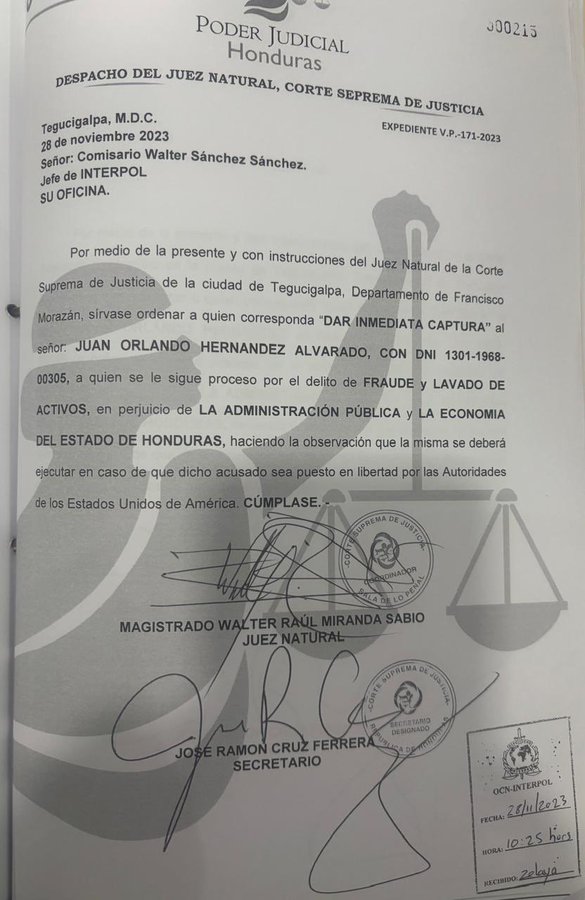
Shortly after his release, the Honduran Attorney General’s Office confirmed that longstanding warrants tied to domestic allegations of fraud and money laundering were still active. These charges stem from investigations conducted in 2023 involving the misuse of public funds, alleged financial improprieties, and the potential diversion of state resources to political campaigns.
The Attorney General announced that the conditions for activating the domestic warrant had been satisfied: Hernández was no longer in U.S. custody and was therefore eligible for immediate legal action under Honduran law. As a result, an international arrest warrant was issued and circulated to law enforcement agencies, including INTERPOL. Honduran officials emphasized that this step was part of a broader initiative to combat corruption and ensure accountability among public officials, past and present.
This renewed push to prosecute Hernández domestically signals a strong shift in Honduras’s legal and political environment. It reflects a growing trend in Latin America, where former heads of state are increasingly being investigated or prosecuted for corruption, misuse of funds, and abuse of power.
A Politically Sensitive Moment for Honduras
The timing of the arrest warrant coincides with a politically charged period in Honduras. Recent elections and political transitions have created an environment where issues surrounding corruption, transparency, and governance are under heightened scrutiny. The Hernández case has become a symbol of that national struggle.
For the current Honduran administration, the case represents an opportunity to demonstrate a commitment to the rule of law. By taking action against a former president, the government signals its resolve to break patterns of impunity that have historically shielded political elites from accountability.
However, supporters of Hernández argue that the charges represent an attempt to destabilize his political base and silence dissenting voices. They claim the current government is exploiting the legal system to weaken opposition parties and consolidate political power.
International and Diplomatic Implications
The issuance of an international arrest warrant also carries significant diplomatic implications. Honduras must now cooperate closely with governments and international institutions to secure Hernández’s apprehension. This may involve negotiations, extradition agreements, and complex legal procedures depending on Hernández’s current location.
At the same time, the United States faces questions about its handling of the pardon. While the U.S. government is not obligated to re-arrest Hernández on behalf of Honduras, the situation may influence U.S.–Honduras relations, especially in ongoing cooperative efforts to combat drug trafficking and corruption.
Furthermore, the case highlights a larger global reality: legal accountability does not end at national borders. Even with support from powerful foreign allies, individuals accused of corruption or criminal acts may still face consequences from their home countries or international authorities.
Conclusion
The arrest warrant for Juan Orlando Hernández is more than a legal procedure—it is a moment that reflects Honduras’s evolving approach to governance, justice, and political accountability. Whether Hernández ultimately faces trial in Honduras will depend on multiple factors, including international cooperation, domestic political developments, and the strategic decisions of his legal team.
Regardless of the outcome, the case stands as an important reminder that former political power does not guarantee immunity. It also marks a significant chapter in Honduras’s fight against corruption and its effort to strengthen the rule of law.