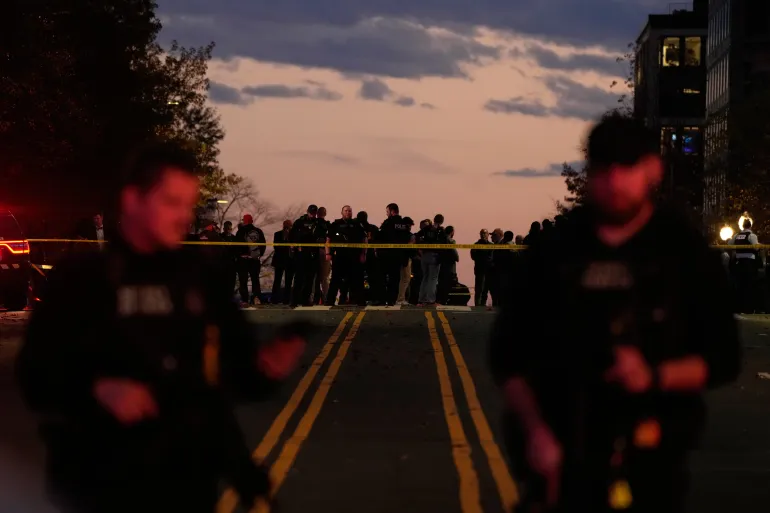
The afternoon of November 26, 2025, will likely be remembered as one of the most unsettling moments in Washington, D.C.’s recent history. What began as an ordinary day in the busy downtown district turned into a scene of chaos when two United States National Guard members were shot only a short walk from the White House. The incident, which unfolded near the intersection of 17th and I Streets NW, forced the city into an immediate security lockdown and raised serious questions about the safety of both law-enforcement personnel and civilians in one of the most secure regions of the country.
A Sudden Attack in the Heart of the Capital
According to officials, the shooting occurred during the early afternoon when two National Guard members were conducting a routine patrol. These patrols had become a familiar sight across Washington since late summer, following federal decisions to bolster on-ground security through the deployment of uniformed Guard personnel.
Eyewitnesses said the gunfire broke out without warning, creating a scene of chaos and fear. People on the sidewalk reportedly ducked behind structures, sprinted into nearby shops, or sought shelter inside office buildings as multiple shots rang out in quick succession. Within minutes, alarms sounded, police vehicles converged on the scene, and medics rushed to treat the wounded Guardsmen.
Despite the proximity to one of the most heavily monitored areas in the United States — only blocks from the White House campus — the attacker managed to approach the soldiers at close range. Officials later described the assault as intentional and “targeted,” rather than the result of random violence.
Suspect Apprehended After Rapid Response
Law-enforcement sources confirmed that the attacker was subdued shortly after the shooting. He was injured during the confrontation and later taken into custody for medical treatment and interrogation. While the full details about the suspect’s background have yet to be released publicly in full, authorities revealed that he acted alone and that early evidence suggests a deliberate attempt to target the National Guard members.
The two injured Guardsmen were immediately transported to nearby hospitals and remain in critical condition. Medical teams worked urgently to stabilize them, while military officials notified their families and activated support services.
A City Placed Under Lockdown
News of the attack prompted a swift and sweeping response across Washington. Streets near the shooting were sealed off with police tape; businesses closed their doors; public transportation in the area was temporarily halted. Helicopters circled overhead as federal and local law-enforcement agencies coordinated to secure the surroundings and ensure no additional threats were present.
The White House itself was placed under heightened alert, with Secret Service agents increasing patrols and restricting movement around the perimeter. Although no direct threat to the presidential residence was identified, officials took no chances — especially given the location and timing of the attack.
Political and Legal Tensions Intensify
Even before the shooting, the presence of National Guard troops in Washington had become the subject of national debate. Critics argued that the extended deployment represented an overreach of federal authority and blurred the line between military and civilian policing. Supporters maintained that the added forces were necessary to counter rising security concerns in the nation’s capital.
The attack has now amplified those debates. Proponents of the deployment claim that the shooting demonstrates the very dangers Guard members are tasked with protecting against. Meanwhile, opponents contend that placing military personnel in visible positions on city streets increases their vulnerability and risks escalating violence.
The judicial system had also recently weighed in, with court rulings questioning portions of the Guard’s domestic deployment. The new incident could complicate legal proceedings and force policymakers to revisit the boundaries of federal authority during times of heightened security tension.
Community Reaction: Fear, Confusion, and Concern
For residents, office workers, and tourists in the area, the shooting was deeply unsettling. Many reported feeling shocked that such an attack could occur in broad daylight in a location widely regarded as one of the safest in the country. The sense of security that typically accompanies the presence of uniformed personnel appeared to falter, replaced by uncertainty and a renewed awareness of vulnerability.
Social media lit up with eyewitness accounts, safety alerts, and messages of support for the wounded soldiers. Community leaders and clergy groups issued statements calling for calm, unity, and resilience in the wake of the attack.
Implications for National Security and Public Policy
The broader implications of the attack reach far beyond the immediate tragedy. Federal agencies are now reviewing the protocols under which National Guard personnel operate within the city — including equipment, patrol patterns, and levels of protective support. Questions have emerged about whether Guard members should be accompanied by police officers, whether their training for urban environments is adequate, and whether alternative security models should be considered.
Immigration and refugee policies may also come under renewed scrutiny. Given the reported background of the suspect, political leaders may call for reviews of screening procedures, vetting timelines, and monitoring practices for newcomers resettled under emergency or humanitarian programs. Such discussions are likely to become deeply politicized in the coming weeks.
A Turning Point for Security in Washington
The shooting represents more than an isolated act of violence; it highlights a growing challenge facing American cities. As threats evolve and political polarization intensifies, balancing safety, civil liberties, and the appropriate use of military resources has become increasingly complex. The incident near the White House may serve as a critical moment — one that forces the country to re-evaluate how it safeguards its capital, protects its personnel, and prepares for emerging risks.
For now, the priority remains the recovery of the two critically injured Guardsmen and the completion of an exhaustive investigation. But the repercussions of this attack will almost certainly shape both local and national policy discussions for months, if not years, to come.