In a world where international drug trafficking continues to evolve in complexity, speed, and scale, maritime forces face extraordinary challenges. Hidden far from the public eye, thousands of miles off the coastline, an intense cat-and-mouse game unfolds daily—one that determines whether billions of dollars’ worth of narcotics make it into global markets or are intercepted before they ever reach land.
Recently, the United States Coast Guard executed one of the most significant drug-interdiction operations in its history, seizing a massive quantity of cocaine from a fast-moving smuggling vessel during Operation Pacific Viper. The dramatic encounter, captured on video, showcased the remarkable precision, risk, and professionalism required to shut down a high-speed criminal enterprise on open waters.
The operation revealed not only the resilience of the Coast Guard but also the growing sophistication of drug cartels that attempt to outmaneuver authorities. As the footage circulated, people around the world caught a rare glimpse into the adrenaline-charged world of maritime law enforcement—a world where seconds matter, waves are unpredictable, and every decision has life-or-death consequences.
Operation Pacific Viper: A High-Stakes Mission
Operation Pacific Viper is a multi-agency, multinational effort aimed at disrupting illicit trafficking across the vast Pacific Ocean. Drug cartels often rely on “go-fast” boats—sleek, powerful, low-profile vessels that can outrun many law-enforcement ships. These boats are designed for speed, stealth, and long-distance travel, often carrying thousands of pounds of contraband.
During the recent operation, a Coast Guard aircraft spotted one such vessel cutting through open waters with unusual speed. Its trajectory and behavior matched known smuggling patterns. The mission quickly escalated into a coordinated pursuit involving air and sea units, each trained to respond with tactical precision.
What followed was a meticulously choreographed interception. As the suspect vessel ignored warnings and continued to flee, the Coast Guard deployed one of its specialized airborne teams—a crew trained to stop high-risk boats by disabling their engines from the air. This method is used only when absolutely necessary, given its difficulty and inherent danger.
A Dramatic Interdiction Caught on Camera
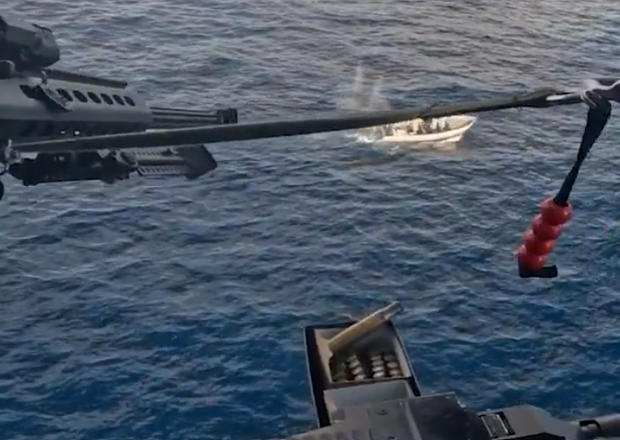
The now-viral footage shows a helicopter hovering above the speeding smuggling vessel. Despite rough waters and unpredictable movement, the helicopter crew maintained perfect formation. After issuing repeated instructions to stop—none of which were obeyed—the armed crew member executed a disabling-fire tactic, precisely targeting the vessel’s engines.
Within moments, the boat lost power.
As the engines sputtered out, the small craft drifted helplessly on the waves. The scene represented a major victory: a dangerous high-speed chase brought to a safe and controlled stop without loss of life. Shortly afterward, Coast Guard personnel boarded the vessel and discovered an enormous cache of cocaine packed into tightly sealed bundles.
This seizure alone represented one of the largest recovered from a single boat in Pacific waters—an achievement that underscored the effectiveness of Operation Pacific Viper and the extraordinary skill of those involved.
The Scale and Impact of the Seizure
The amount of cocaine discovered aboard the vessel was staggering. Each brick, wrapped meticulously to survive sea travel, symbolized not only millions in illicit profits but also the broader consequences that such narcotics inflict on communities around the world.
By stopping this shipment at sea:
-
Countless doses of dangerous drugs were prevented from entering neighborhoods
-
Major financial losses were inflicted on drug-trafficking organizations
-
Lives were potentially saved from addiction, violence, and overdose
-
Ongoing investigations gained new momentum through evidence and intelligence
The seizure was part of a broader wave of interdictions under Operation Pacific Viper, which collectively removed an unprecedented amount of cocaine from transnational criminal networks. The operation also highlighted the importance of global cooperation, as many such missions involve intelligence sharing and teamwork among different nations.
Inside the Life of a Coast Guard Crew
For the personnel involved, missions like this are the result of years of training, physical conditioning, and real-world experience. Every member of the crew—pilots, gunners, navigators, boarding teams, and deck officers—must perform flawlessly, often under intense pressure.
Conditions at sea are rarely predictable. Weather shifts, waves grow, and visibility can collapse without warning. Yet the Coast Guard crews repeatedly step into this environment, guided by discipline, teamwork, and a deep commitment to public safety.
The interception featured in the video was a powerful demonstration of how seamlessly these teams operate. While viewers saw only a few moments of intense action, the operation involved hours of coordination, rapid decision-making, and precise execution.
Why Maritime Drug Interdiction Is So Critical
International waters are vast—so vast that no single nation can patrol them alone. Drug cartels exploit this immensity, using hidden routes that stretch across thousands of miles. A single smuggling boat can carry enough narcotics to flood entire regions, fueling crime, addiction, and instability.
Thus, stopping these shipments at sea is one of the most effective strategies for combating global drug trafficking. Unlike street-level seizures, maritime interdictions cut the supply chain at its source, long before the drugs reach distributors or dealers. Each successful operation disrupts criminal networks, weakens their finances, and protects communities.
Operation Pacific Viper is a clear reminder that persistent vigilance and global cooperation are essential to securing maritime pathways and reducing the reach of transnational crime.
A Message for the Future
The Coast Guard’s remarkable interception serves as an inspiring reminder of the bravery and expertise of those who protect our waters. While drug cartels continue to innovate, maritime forces demonstrate again and again that they are capable, prepared, and committed to keeping illicit substances off the streets.
As technology advances and criminal organizations adapt, operations like Pacific Viper will remain a crucial tool in defending coastlines, safeguarding families, and ensuring that the ocean remains a place of opportunity—not exploitation.
This historic mission is not simply a story of a boat stopped at sea. It is a story of lives protected, chaos prevented, and justice delivered far from the shoreline.
For More Information
-
CBS News – Coast Guard seizures under Operation Pacific Viper
https://www.cbsnews.com/news/coast-guard-cocaine-seizure-operation-pacific-viper-shots-fired-video/ -
CBS News – Record single-boat cocaine seizure
https://www.cbsnews.com/news/coast-guard-seizes-cocaine-single-boat-record-pacific-ocean/ -
U.S. Coast Guard Press Release – Operation Pacific Viper updates
https://www.news.uscg.mil/