
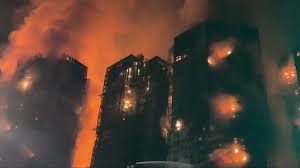
The massive fire that swept through several residential towers in Hong Kong’s Tai Po district has shaken the city to its core. What was expected to be just another ordinary afternoon turned, within minutes, into one of the deadliest residential disasters in Hong Kong’s modern history. The blaze consumed multiple high-rise blocks, left dozens dead, hundreds missing, and thousands displaced. More than a tragedy, this incident has revealed profound flaws in urban safety standards, construction oversight, and emergency preparedness.
Hong Kong, known for its glittering skyline and dense vertical living, suddenly found itself face-to-face with the vulnerabilities hidden beneath its towering architecture. The fire has become a wake-up call—one that demands a reassessment of how a city this modern and advanced could face such a devastating catastrophe.
How the Fire Began — A Small Spark, A Massive Disaster
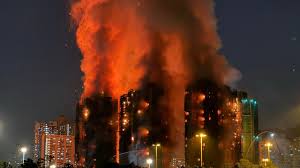
The fire reportedly began on the exterior of one of the towers, where renovation work was underway. Scaffolding made of bamboo—a common feature in Hong Kong due to its affordability and ease of use—was wrapped around the building. While culturally iconic, bamboo is also highly flammable. When the first flames appeared, they climbed the scaffolding at an alarming speed, helped by the protective nylon mesh that acted like fuel rather than a barrier.
Within minutes, the exterior of the building looked like a burning torch. The fire leapt to upper floors, then reached nearby towers that stood only a few meters away. Residents described hearing crackling noises, smelling intense smoke, and watching the flames rise like a wall of fire outside their windows.
Inside, narrow hallways, heavy smoke, and heat created a deadly trap. People scrambled toward staircases, only to find some routes blocked by falling debris or already filled with choking smoke. Others were trapped inside their homes, waving towels and torches from balconies as they waited for rescue.
A Human Tragedy on an Unimaginable Scale
The loss of life was staggering. Dozens of residents perished inside their apartments or on smoke-filled staircases. Among the dead were families who had lived in the building for decades, elderly residents unable to move quickly, and children who never stood a chance against the speed of the flames.
Hundreds more remain unaccounted for. Many families have gone from shelter to shelter searching for missing loved ones. Hospitals soon became crowded with burn victims, people suffering from smoke inhalation, and those injured while trying to escape.
Firefighters fought with extraordinary courage, climbing through collapsing structures and thick smoke. Yet even their heroic efforts were not enough to prevent large-scale destruction. Several firefighters were injured, and one reportedly lost his life in the attempt to save trapped residents.
For thousands of families, the fire meant more than physical injury. Their homes—filled with memories, possessions, and stability—vanished in a single night. What remains is ash, grief, and uncertainty.
Safety Concerns and Systemic Failures
Beyond the heartbreaking human toll, the fire exposed severe issues within Hong Kong’s building safety ecosystem. Residents have long expressed concerns about renovation standards, but this incident made those fears a horrifying reality.
Several critical failures became evident:
1. Flammable External Materials
The use of bamboo scaffolding and plastic mesh created a perfect environment for rapid flame spread. While cost-effective, these materials may no longer be suitable for densely populated high-rise areas.
2. Compromised Fire Protection
Multiple residents reported that fire alarms either did not activate quickly or were not loud enough to alert people deep inside their apartments. In a building housing thousands, even seconds matter.
3. Inadequate Escape Routes
The stairwells, the only means of escape during a fire, filled with smoke too quickly. Some emergency doors were said to be stuck, poorly maintained, or blocked by renovation supplies.
4. Lack of Oversight
Renovation projects on occupied buildings should have stricter supervision. The fire has brought attention to the possibility that safety regulations were not fully enforced.
These failures transformed a small spark into a deadly catastrophe.
Government Response and Ongoing Investigations
Local authorities quickly launched a large-scale investigation. Several individuals associated with the renovation work were detained for questioning, including contractors, engineers, and site supervisors. Authorities are examining whether proper fire-safety protocols were followed, and whether negligence played a role in the tragedy.
City leaders have promised a complete review of building codes. There are calls for:
-
Banning flammable scaffolding materials
-
Requiring dual fire escape routes
-
Mandatory renovation safety audits
-
Regular inspection of fire alarms and smoke barriers
-
Full transparency of construction company records
The government has also opened temporary shelters for the displaced, offering food, psychological support, and emergency financial assistance. Yet for many families, no amount of aid can fill the emotional void left behind.
Voices of the Survivors
In shelters, the stories of survivors paint a picture of terror and resilience.
Parents describe covering their children with wet cloths as smoke seeped under the door.
Elderly residents recall crawling on the floor to find breathable air.
Some say they only survived because neighbors knocked on their doors in time.
Many survivors also express anger—anger that they were not warned sooner, that alarms failed, and that their homes, which they trusted to be safe, became deadly traps.
What This Means for Hong Kong’s Future
This fire will remain etched in Hong Kong’s memory for decades. It is a tragedy that demands deep structural change.
The city must rethink how high-density living is managed. Safety systems must be upgraded, renovation practices re-evaluated, and building oversight strengthened. Hong Kong’s skyline is admired worldwide, but its safety standards must match that global reputation.
Urban planners, engineers, and policymakers now face a monumental task: ensuring that no such disaster ever happens again.
Conclusion
The high-rise fire in Tai Po was more than an accident—it was a revelation. It exposed failures in safety systems, gaps in regulation, and dangerous assumptions about the resilience of modern buildings. It also showed the bravery of ordinary residents and firefighters who risked everything to save others.
As Hong Kong begins the long road to recovery, this tragedy must become a turning point. Only by learning from it, reforming outdated practices, and prioritizing human life over convenience or cost can the city truly honor those who were lost.