
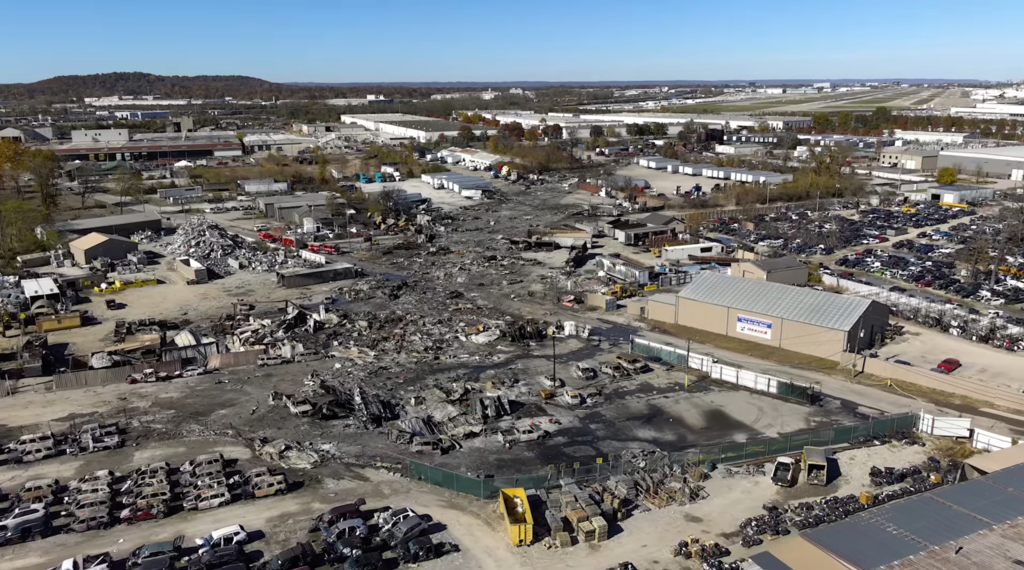
On the afternoon of November 4, 2025, a scheduled domestic cargo flight of UPS Airlines, designated Flight 2976, departed from Louisville Muhammad Ali International Airport (Kentucky) bound for Daniel K. Inouye International Airport in Honolulu, Hawaii. The aircraft was a 34-year-old McDonnell Douglas MD‑11F freighter (registration N259UP) and shortly after take-off, things went catastrophically wrong. The aircraft suffered a separation of its left engine, lost control almost immediately, and crashed into an industrial area beyond the runway. The accident claimed the lives of all three crew members onboard and at least 11 people on the ground, making it the deadliest incident in UPS Airlines’ history to date.
The Flight and the Aircraft
Flight 2976 was a routine cargo route operated by UPS Airlines out of its major hub in Louisville. The MD-11F involved, N259UP, had first flown in 1991, was converted to cargo configuration, and delivered to UPS in 2006. At the time of the accident the aircraft had logged decades of service.
On that Tuesday evening, the plane took off from the runway at about 5:13 p.m. local time. Videos and satellite imagery show a fireball and thick plume of smoke seconds after liftoff. One important detail: within 37 seconds of the crew calling for take-off thrust, a continuous alarm bell sounded in the cockpit voice recorder — a warning of something critical. The crew attempted to regain control for about 25 seconds but were unsuccessful. The aircraft peaked at only about 100 feet above the ground, rolled, then plunged into an industrial zone just beyond the airport.
Investigators also recovered that the left-wing engine/pylon had separated from the aircraft during the take-off roll or climb-out, and debris from that engine was found on the runway. An area of focus is the structural integrity of that pylon and its maintenance history.

Human and Ground Impact
The three crewmembers, identified as Captain Richard Wartenberg, First Officer Lee Truitt and Relief Officer Captain Dana Diamond, were killed on board. On the ground, the crash destroyed two nearby businesses and resulted in at least 11 additional fatalities. Fifteen people were treated for injuries at local hospitals. Families, first-responders and the community in Louisville were faced with a tragic and chaotic afternoon of rescue, fire-fighting, debris removal, and investigation. The human cost was immense, and the local impact was deeply felt.
Immediate Response and Aftermath
First responders rushed to the crash site. The fireball and smoke plume were visible for miles; satellite imagery captured a thermal signature beginning around 22:16 UTC (5:16 p.m. local). Local authorities issued orders to shelter in place and advised residents to turn off external air handling systems, as the crash-site fire involved burning aviation fuel. In the immediate aftermath, the airline issued a statement expressing condolences, identifying crew names, and confirming cooperation with the investigating authority, the National Transportation Safety Board (NTSB). The company also announced the grounding of all its MD-11 freighters “out of an abundance of caution” while investigations continued.
Investigation and Technical Issues
The NTSB launched a full investigation. Key early facts include:
-
The cockpit voice recorder (CVR) was recovered and contained two hours and four minutes of good-quality audio, including the last 25 seconds of the flight.
-
The flight data recorder (FDR) was also recovered and yielded usable data despite the severe fire damage.
-
The left-wing engine pylon separation is under intense scrutiny. The presence of debris on the runway and indications that that engine was still partially attached to the pylon suggest structural failure.
-
The aircraft had recently undergone heavy maintenance, including a six-week period in San Antonio, Texas, for repairs and inspections. Investigators are examining maintenance records, structural integrity, fatigue, corrosion, and the suitability of the inspection regime for an ageing freighter fleet.
-
The NTSB emphasized that multiple factors may be involved—there is no immediate single causal conclusion yet.
-
Until the final report is published (which may take many months), only preliminary findings are being released.
Significance and Broader Implications
This crash holds multiple significant implications for aviation, freight operations, and ageing cargo aircraft fleets.
Firstly, it underscores the risks posed by older aircraft and the need for rigorous structural oversight. The MD-11, while once the workhorse of cargo operations, is aging and some carriers are phasing it out. A separation of an engine/pylon at such a critical phase of flight (take-off/climb) is extremely rare but potentially catastrophic. The incident invites fresh examination of maintenance protocols for freight aircraft, especially those with long years of service and heavy cycles.
Secondly, the crash raises questions about the operational fleet decisions of major carriers. UPS promptly grounded its MD-11 freighters after this accident, recognizing the potential systemic risk—even though the cause was still under investigation. That move signals how serious airlines must treat safety even before all facts are known. Customers, supply-chains and logistics networks are inevitably affected, but those considerations cannot override the primacy of crew and ground-safety.
Thirdly, the human dimension is chilling: cargo flights often operate without passengers, but the risks are real for crew and for those on the ground. An industrial zone adjacent to an airport is typically regarded as a lower-risk area compared to dense residential neighbourhoods—but the consequences here were tragic nonetheless. The crash destroyed businesses, killed ground personnel and disrupted operations in an airport hub that handles massive freight flows each day.
Finally, this event may prompt regulatory scrutiny and industry reevaluation. Ageing aircraft, high cycles, intense usage and frequent maintenance returns all demand vigilance. Regulators may look more closely at cargo operations, maintenance oversight, structural integrity of pylon/wing interface, and crew training for engine-separation emergencies.
Moving Forward: What Happens Next
As the investigation continues, several important actions and changes are either underway or likely:
-
The NTSB will release a preliminary report within about 30 days, followed by a full final report months later. The CVR transcript, FDR data and structural analysis will be central to the findings.
-
UPS and other carriers using similar aircraft will reassess maintenance programmes, inspection intervals, fleet-age exposures, especially for the MD-11.
-
Ground safety around airports may be reviewed—industrial zones near runways, fuel-fire vulnerability, escape or evacuation pathways for crew and ground personnel.
-
The aviation community will study engine/pylon design, fatigue life of attachments, historical antecedents (for example other major accidents where engine separation led to catastrophic outcomes) and whether fleet-wide inspections are required.
-
Logistics and freight customers may face temporary disruption or rerouting while grounded fleets are replaced or inspected. UPS has already activated contingency plans to maintain service reliability while its MD-11 fleet is grounded.
-
Training for crews may be enhanced to include rare but catastrophic events like engine/pylon separation right after take-off—a phase of flight where time is minimal and margins are thin.
A Legacy of Lessons
While the loss is tragic, every such accident offers lessons that the aviation industry must absorb so that the same mistake does not happen again. The crash of UPS Flight 2976 can serve as a catalyst for change—from ageing-aircraft monitoring, structural maintenance practices, cargo–freighter safety culture, to ground-zone planning around major airports.
For UPS Airlines, the incident will mark a pivot point in how it manages its freighter fleet, particularly the MD-11. For the broader industry, it will be a reminder that even a milestone operator in cargo logistics is not immune to fundamental aerodynamic or structural threats. For regulators, it will reaffirm that safety must drive every decision, especially when older airframes, high usage, and intensive operations intersect.
Conclusion
The crash of UPS Airlines Flight 2976 remains a sobering moment in aviation history. It is a reminder that even in an age of advanced technology and strong safety culture, the margins for error at critical phases of flight are razor-thin. A separation of a major engine/pylon at takeoff, followed by loss of control, led to a tragic loss of life—of crew members and people on the ground.
However, it is also an opportunity: an opportunity to reinforce the importance of fleet-structure oversight, rigorous maintenance, robust investigative culture, and collective commitment to safety. As the NTSB investigation unfolds, the findings will doubtless lead to changes, as they must. And the memories of those lost will shape a safer tomorrow.
We owe it to their legacy—and to every future flight—to learn, to adapt, and to ensure that cargo operations, in the service of commerce, never compromise on the fundamental principle: safety first.