
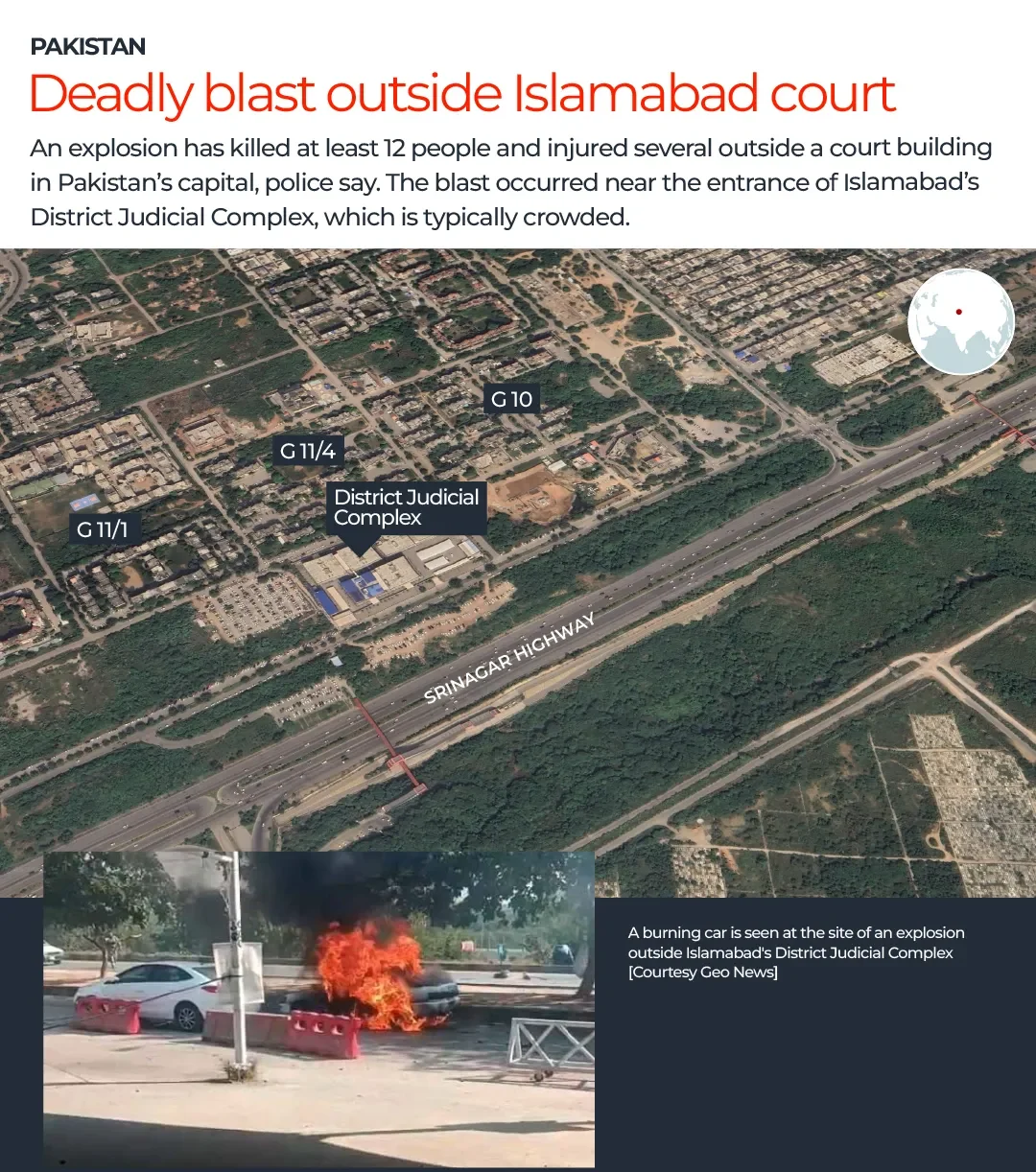
A shocking suicide attack outside a district court in Islamabad, Pakistan’s capital, has left at least 12 people dead and more than 25 injured, bringing renewed attention to the ongoing security challenges in the country. The explosion occurred near the entrance of the court premises, where a police vehicle was parked, and reportedly targeted law enforcement personnel after the attacker failed to gain entry into the building itself. The victims included court visitors, passersby, and police officers, reflecting the indiscriminate nature of such acts of terror.
Immediate Aftermath
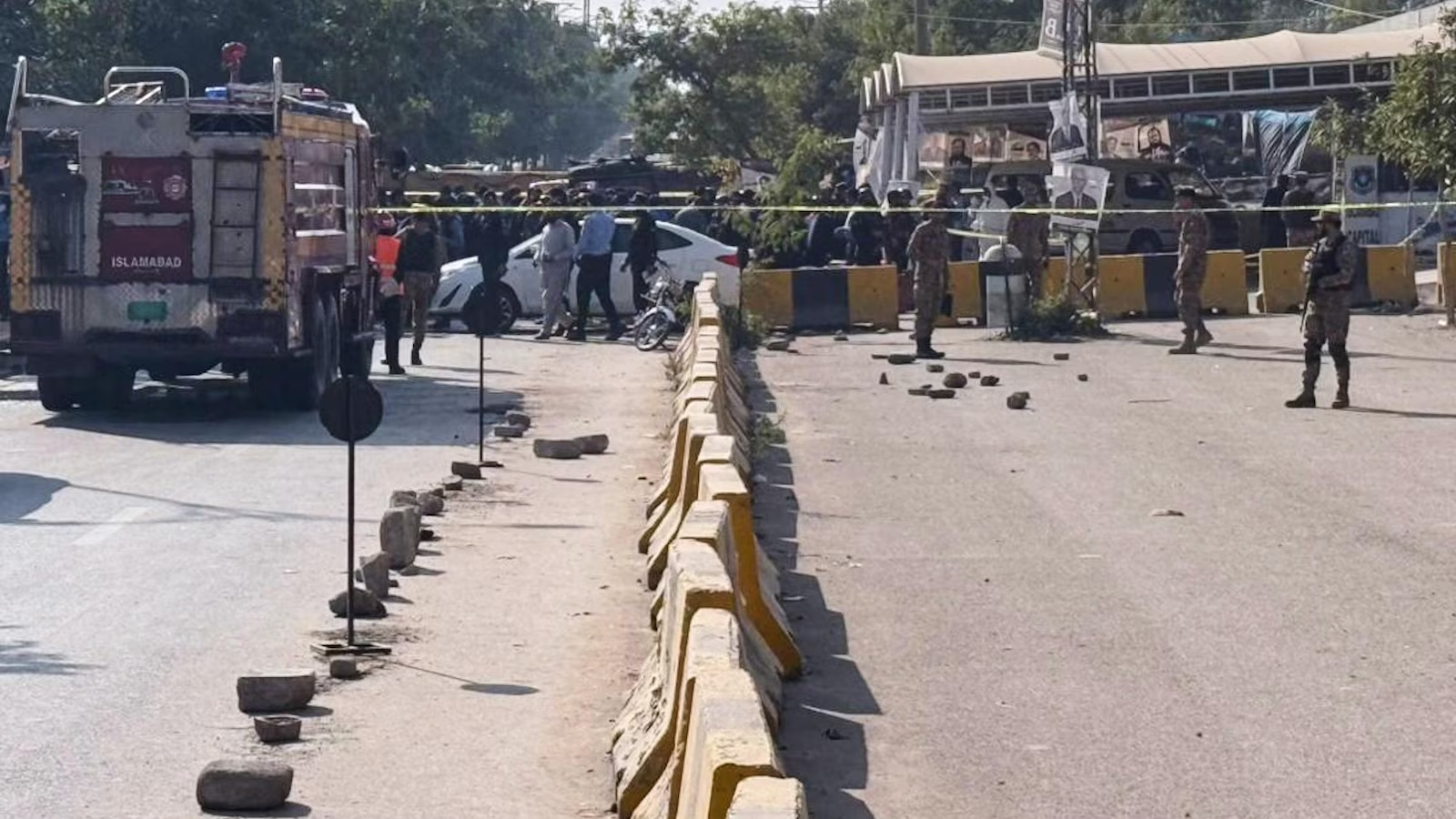
Following the explosion, Islamabad police and emergency services rushed to the scene. Forensic teams cordoned off the area and began collecting evidence to understand the exact nature of the attack. Ambulances transported the injured to nearby hospitals, where doctors were working around the clock to provide treatment. Eyewitnesses described a scene of chaos, with smoke filling the air, debris scattered across the street, and frightened onlookers attempting to flee the area.
Authorities quickly described the incident as a terrorist attack. While no group has yet claimed responsibility, Pakistan has previously witnessed similar attacks carried out by militant organizations, including factions of the Tehreek-e-Taliban Pakistan (TTP) and other extremist networks operating along the Afghan border. These groups often target government installations, courts, and law enforcement agencies in their attempts to destabilize the state.
Geopolitical Tensions and Accusations
The attack has further strained relations between Pakistan and neighboring countries, particularly Afghanistan and India. Pakistan’s federal government accused India and Afghanistan of indirectly supporting cross-border terrorism. Officials claimed that militants receive logistical, financial, or ideological backing, allowing them to plan attacks on Pakistani soil. Prime Minister Shehbaz Sharif described the attack as “state-backed terrorism”, urging the international community to recognize and condemn such actions.
Pakistan’s Defence Minister also made strong statements, emphasizing that the country is effectively “in a state of war” due to repeated cross-border militant activities. He urged the Afghan government to take decisive action against terrorist groups operating from Afghan territory. This public accusation highlights the ongoing challenges Pakistan faces in maintaining security along its porous border with Afghanistan, where militant networks have historically found refuge.
Historical Context of Attacks on Pakistani Courts
Courts and judicial institutions have frequently been targeted by militants in Pakistan. The rationale is often twofold: first, to attack symbols of state authority, and second, to create an atmosphere of fear among law enforcement personnel, judges, and the general public. Previous attacks on courts in regions like Khyber Pakhtunkhwa and Punjab have resulted in significant casualties and heightened security measures.
This latest attack in Islamabad, the nation’s capital, marks a particularly worrying escalation. Unlike other regions where militant activities are somewhat localized, the attack in the federal capital demonstrates that no area is immune. It underscores the militants’ capacity to strike high-profile targets, even in heavily guarded areas.
Security Response
In response to the bombing, Islamabad police intensified security measures throughout the city. Checkpoints were established at major intersections, surveillance was increased around government buildings, and rapid-response teams were deployed to monitor any further threats. The judiciary also reviewed court schedules, with some hearings temporarily postponed to ensure safety.
The federal government emphasized that intelligence agencies are actively tracking militant networks suspected of involvement. Coordination between the intelligence community, law enforcement, and military has been strengthened to prevent future attacks. Security analysts suggest that such coordination is crucial, as militants often exploit gaps in surveillance or rely on insider assistance to carry out operations.
Public Reaction
The attack sent shockwaves throughout Pakistan, particularly among citizens in Islamabad. Social media was flooded with messages of solidarity for the victims and condemnation of the violence. Families of the deceased and injured have called for swift justice, while ordinary citizens expressed concern about the safety of public spaces, especially government institutions.
Political leaders from various parties condemned the attack. President Asif Ali Zardari expressed condolences and praised law enforcement agencies for their prompt response. Meanwhile, community leaders and religious figures urged calm and emphasized national unity against terrorism.
Regional Implications
The Islamabad court bombing also highlights the complex security dynamics in South Asia. Pakistan has long faced the challenge of cross-border militancy, with extremist groups using neighboring countries as operational bases or training grounds. The recent escalation threatens to destabilize diplomatic relations and may lead to increased border security measures, stricter travel protocols, and potential retaliatory actions.
The attack also raises questions about Pakistan’s internal security policies. Experts argue that despite numerous counter-terrorism operations, the persistence of such attacks indicates that militant networks remain resilient. The government may need to revisit intelligence strategies, enhance community policing, and strengthen cooperation with international partners to address the root causes of militancy.
Humanitarian Concerns
Beyond the immediate fatalities and injuries, attacks like these have profound humanitarian implications. Survivors often experience long-term psychological trauma, while families of the deceased face economic and social hardships. Hospitals and emergency services are placed under extreme pressure, particularly when multiple casualties occur simultaneously.
Aid organizations and NGOs have called for increased support for victims, including medical care, counseling services, and financial assistance. Local communities have also organized fundraising and volunteer efforts to assist affected families.
Conclusion
The suicide bombing outside the Islamabad district court serves as a stark reminder of the persistent threat of terrorism in Pakistan. With 12 lives lost and many more injured, the attack underscores the urgent need for robust security measures, regional cooperation, and sustained efforts to dismantle militant networks. The incident also highlights the challenges of maintaining public safety in the face of evolving terrorist tactics.
As Pakistan grapples with these threats, it is crucial for authorities to balance security enforcement with

