
October 26, 2025 | Paris, France
In a dramatic turn of events following one of France’s most audacious art heists, Paris prosecutors announced the arrest of two suspects linked to the theft of priceless crown jewels from the world-famous Louvre Museum. The arrests come exactly one week after the meticulously planned robbery that stunned the nation and raised questions about museum security at one of the world’s most secure cultural institutions.
The Arrests and Ongoing Investigation
Paris prosecutor Laure Beccuau confirmed on Sunday that investigators apprehended two individuals on Saturday evening in connection with the high-profile theft. One of the suspects was captured at Roissy–Charles de Gaulle Airport as he was allegedly preparing to flee France for Algeria. Both men, aged in their 30s and reportedly “known to police,” are currently in custody and could be detained for up to 96 hours under French law.
According to law enforcement sources quoted by The Associated Press, one of the suspects was identified through DNA evidence recovered at the scene. Forensic teams had been analyzing over 150 traces collected from the Louvre’s Apollo Gallery, the section of the museum that houses France’s historic Crown Jewels.
The investigation is being led by a specialized police division that handles armed robberies, major burglaries, and art thefts. Over 100 officers are said to be working on the case, which authorities describe as one of the most significant museum robberies in recent French history.
Prosecutor Beccuau criticized the premature media leaks regarding the arrests, warning that such disclosures could jeopardize the ongoing investigation and efforts to recover the stolen jewels. She noted that more details would be released once the suspects’ custody period concludes.
A Bold Heist in Broad Daylight
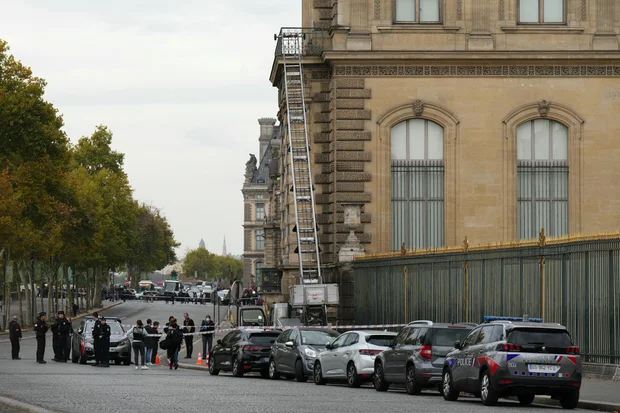
The theft occurred on the morning of October 19, 2025, when thieves executed a precision-planned operation lasting less than eight minutes. Using a construction-style basket lift, the perpetrators scaled the Louvre’s façade, broke through a window, smashed reinforced display cases, and fled with eight priceless royal artifacts.
Security footage — or the lack thereof — has become a major point of concern. Authorities are investigating whether security cameras malfunctioned or were disabled, allowing the thieves to operate undetected for crucial minutes. The museum’s director called the breach a “terrible failure” and vowed to cooperate fully with the ongoing investigation.
French Interior Minister Laurent Nunez publicly praised the investigators, stating:
“They have worked tirelessly, just as I asked them to, and they have my full confidence. The recovery of these jewels is a national priority.”
What Was Stolen
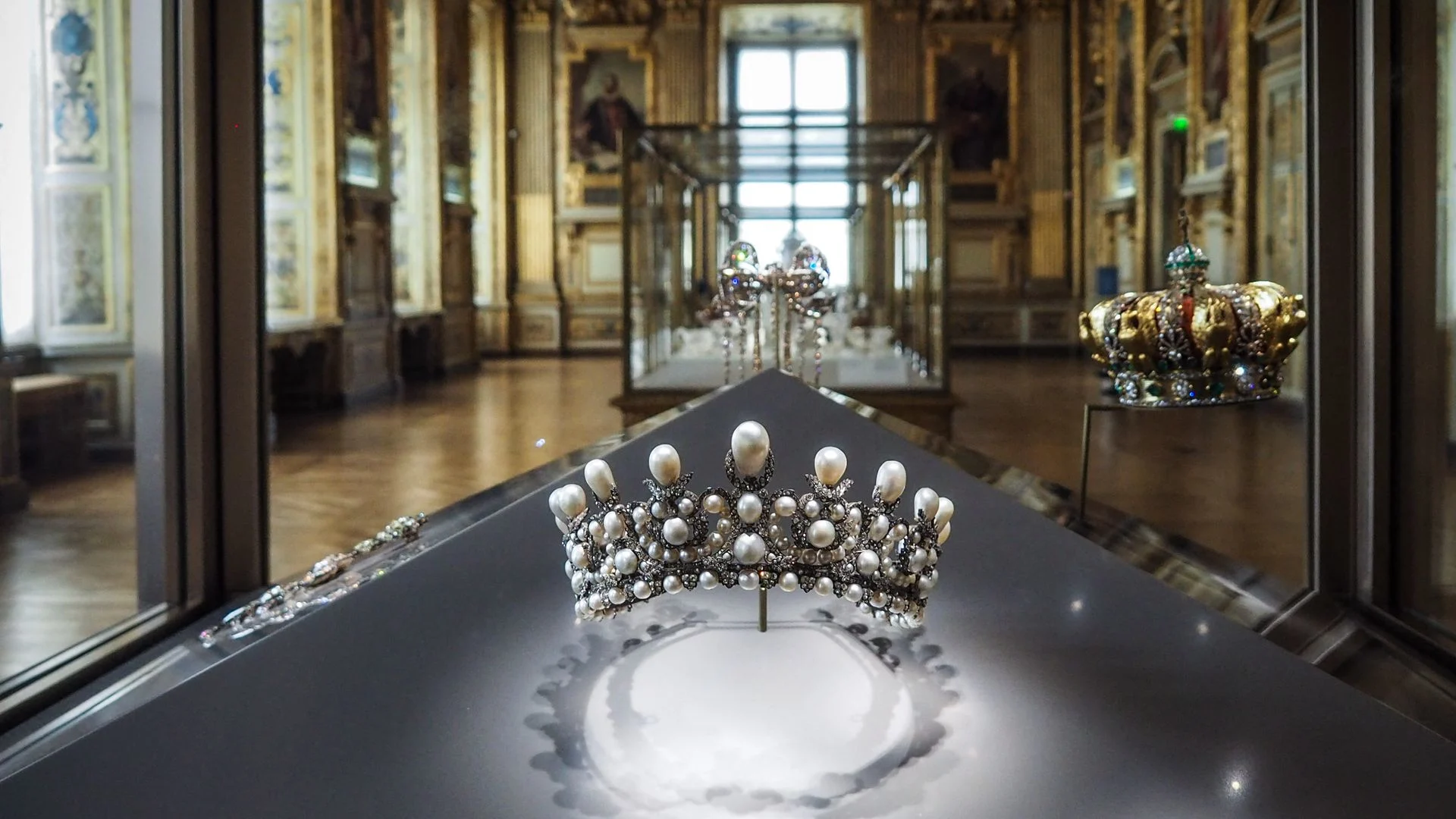
The targeted gallery — the gilded Apollo Gallery, one of the Louvre’s crown jewels itself — is home to the French Crown Diamonds and other historic treasures. Officials confirmed that eight pieces were stolen, each of immense historical and cultural value:
-
A sapphire diadem, necklace, and single earring set belonging to 19th-century queens Marie-Amélie and Hortense.
-
An emerald necklace and matching earrings once owned by Empress Marie-Louise, the second wife of Napoleon Bonaparte.
-
A reliquary brooch of significant religious importance.
-
The diadem and corsage-bow brooch of Empress Eugénie, wife of Napoleon III, considered among the most exquisite examples of 19th-century French craftsmanship.
One artifact — Eugénie’s emerald-studded imperial crown, adorned with more than 1,300 diamonds — was later discovered outside the museum grounds, damaged but salvageable.
Experts estimate the jewels’ combined market value at over $102 million, though their historical worth is considered priceless.
Security Concerns at the Louvre
The robbery has sparked a national debate over museum security protocols. The Louvre, which attracts more than 8 million visitors annually, is equipped with extensive surveillance systems and 24-hour security. Yet, the fact that thieves managed to infiltrate the building using external equipment has raised alarms about potential procedural lapses.
Some reports suggest that the robbers may have exploited an ongoing maintenance project to disguise their approach and that security cameras along the façade may have been tampered with or temporarily offline.
A senior museum official, speaking on condition of anonymity, told Le Parisien,
“It is impossible to imagine such a theft without inside knowledge of the museum’s layout and timing.”
Cultural and Financial Fallout
The French Ministry of Culture confirmed that the stolen pieces were not insured, citing national laws that prohibit public museums from insuring their collections except when artworks are loaned out. According to Romain Déchelette, president of Serex Assurances, this policy means the Louvre will bear the full financial loss should the jewels not be recovered.
While the monetary value is immense, art historians emphasize that the true loss lies in the cultural and symbolic heritage represented by these royal artifacts. The stolen items embody the legacy of France’s imperial history — from the reign of Napoleon to the splendor of 19th-century French monarchy.
A Race Against Time
Authorities are now in a race to recover the missing jewels before they are dismantled and sold on the black market, where such artifacts could be worth millions if broken down into individual gems.
Interpol and Europol have reportedly been alerted, and border agencies across Europe are on high alert for any attempts to traffic the stolen diamonds and gemstones.
Prosecutor Beccuau emphasized that the investigation is far from over:
“We are determined not only to apprehend all those involved but to recover every piece of France’s cultural heritage that was stolen.”
Conclusion
The Louvre heist of 2025 has already entered the annals of modern art crime — a sophisticated, high-stakes theft executed with near-military precision. While the arrest of two suspects marks a significant breakthrough, the case remains open and fraught with challenges.
As France’s most renowned museum grapples with the aftermath, the world watches closely — waiting to see whether justice will restore not just the missing jewels, but also the public’s faith in the security of the world’s greatest cultural treasures.

