

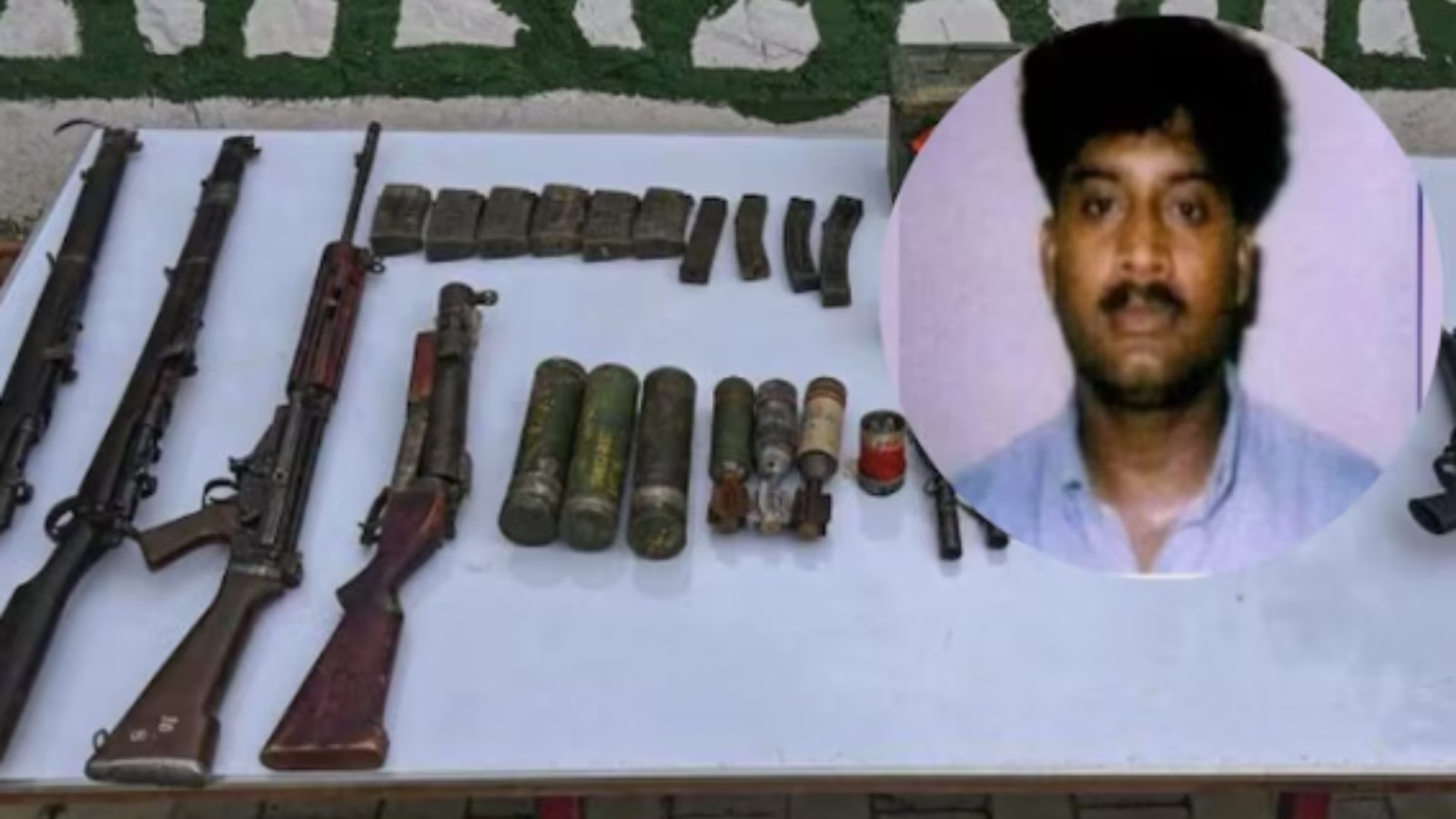
Sheikh Salim, who was famed in the criminal community as the Salim Pistol, was later arrested in Nepal after years of evading the law, after breaking the laws of the country. Salim was once regarded as the most desirable arms supplier in India, and he had developed a huge network that smuggled high-grade weapons across the borders, which facilitated gang wars, organized crime, and politically-driven violence. His arrest on August 9, 2025, off the Indo-Nepal border is a turning point in the current fight by India against the illegal trafficking of arms.
Salim worked in the shadows over a period of 10 years, making shipments, hiring operatives, and supplying weapons to criminal syndicates in the nation that are the most notorious in the country. His name was often found in the context of high-profile murders, such as the 2022 assassination of Punjabi singer Sidhu Moose Wala. The chase after Salim turned out to be one of the longest criminal investigations in India, and its success demonstrates the increased capacity of cross-border intelligence and law enforcement partnerships.
The Emergence of a Notorious Weapon Smuggling Kingpin
Salim started his criminal life in Seelampur, a neighborhood of Delhi that had many people living in crammed streets with very few avenues for making a living. Leaving school at the eighth grade, Salim first resorted to minor theft, swindling, and auto-related offenses. Gradually, he shifted to a more advanced form of crime that finally made him one of the most dangerous arms brokers in India.
It has been found out that Salim was involved in smuggling Zigana pistols, which are a kind of semi-automatic firearm, and other advanced weapons between Pakistan and India. These guns were subsequently involved in gang conflicts, contract killings, and major criminal activities in the northern part of India. His clients have allegedly included some of the most infamous names, including Lawrence Bishnoi and Hashim Baba, and his guns have been directly linked to killings and crime sprees.
The government accuses him of having extensive international contacts through his network. It is also speculated by intelligence reports to have ties with Pakistan Inter-Services Intelligence (ISI) and the underworld syndicate, D-Company, based on the leadership of Dawood Ibrahim. This international operation not only posed a threat to the internal security of India but also provided the challenges of transnational criminal networks within the South Asian region.
The Takeover: A Cross-Border Operation at Stake
Having been on the run for many years, Salim was eventually arrested due to careful planning and months of intelligence development. Salim was working under a false name and tried to enter Nepal to strike a deal on the weapons. He had been hunted by a joint task force consisting of the Delhi Police Special Cell, Criminal Investigation Department (CID), and Nepal Police, who had been tracking him down over several weeks.
On August 9, 2025, the police apprehended Salim near the town of Birgunj, an important trade hub on the Indo-Nepal border. False papers, hundreds of foreign SIM cards, and large sums of money, believed to be used in bribery and smuggling, were recovered. Salim tried to escape but was restrained quickly without creating any violent conflict.
One of the seniors of the Delhi Police Special Cell remarked, “Salim Pistol was a very clever and careful criminal. It was important to coordinate with our Nepalese counterparts so that we could make a safe arrest and nobody would be killed. This is a major success of cross-border policing.”
Intelligence Operations and CID
The Criminal Investigation Department (CID) was instrumental in hunting and apprehending Salim. Months of observation of his encrypted communications, financial transactions, and movement patterns helped identify his operations. Digital forensics, surveillance footage, and human intelligence all contributed to forming a detailed portrait of his criminal network.
The breakthrough came when one of the informants in Delhi revealed that Salim planned to cross the border. With this information, the CID organized a sting operation in coordination with the Intelligence Bureau (IB) and Nepal Police. The international cooperation not only neutralized Salim’s escape plan but also sent a strong message about the reach and efficiency of modern law enforcement operations.
National Response: A Win for Security Forces
The capture of Salim caused strong reactions among law enforcement, government officials, and security analysts. Delhi Police Commissioner Sanjay Arora described it as a major victory against the illegal arms pipeline that fuels gang wars and terror activities. Security analyst Ajai Sahni emphasized that “This arrest shows that intelligence-led policing and international cooperation work. It disrupts one of the most well-established criminal networks operating in India today.”
Public responses were equally noteworthy. While many expressed relief and satisfaction, others stressed the need for further investigations into his associates, financial networks, and possible political protectors. The arrest also reignited discussions on enhancing border security, improving intelligence coordination, and monitoring transnational crime syndicates more rigorously.
Consequences for Law Enforcement and Prosecution
The arrest is expected to have far-reaching implications for India’s fight against arms trafficking and organized crime. With Salim in custody, authorities aim to dismantle his network, trace finances, and uncover accomplices across India and neighboring countries.
Salim now faces charges under the Arms Act, Unlawful Activities (Prevention) Act, and National Security Act. If convicted, he could face life imprisonment or even the death penalty, depending on the severity of the offenses. Beyond the courtroom, his arrest serves as a warning to other arms dealers and criminal networks: even the most elusive criminals can be caught with determination, planning, and intelligence-led operations.
Analysts predict that this operation may lead to further arrests, disrupt criminal activities, and provide valuable insight into the patterns of transnational smuggling. It also underscores the importance of international cooperation in combating cross-border crime, particularly in South Asia.
Concluding Remarks: A Milestone in the Fight Against Crime
The arrest of Salim Pistol is a major success in India’s struggle against illegal arms and organized crime. While it has not eliminated the broader threat, it proves that coordination, intelligence, and strategic policing can bring down even the most dangerous criminals.
Salim and his network had promoted violence, corruption, and terror over the past decade, but now one of India’s most wanted criminals is behind bars. His arrest is both a milestone and a cautionary tale, demonstrating that the fight against organized crime requires persistence, collaboration, and modern investigative techniques.
India’s security agencies have shown that even the most elusive figures cannot outrun justice forever. As investigations continue, the nation will watch closely, hopeful that this landmark operation will lead to the unraveling of additional criminal networks, a reduction in illegal arms circulation, and ultimately, a safer society.

