
Money laundering is often described as the “lifeblood” of organized crime. Without it, drug traffickers, fraudsters, cybercriminals, and corrupt officials would struggle to enjoy their illegal profits. The process of hiding dirty money and making it appear legitimate is global, complex, and constantly evolving.
Between 2022 and 2024, Dubai Police led one of the region’s most ambitious campaigns against money laundering. Over three years, they investigated 500 cases worth AED 4 billion (around USD 1.1 billion). This wasn’t just about numbers; it was about proving that Dubai is committed to protecting its financial system and international reputation.
Detecting Suspicious Activity:
Every money laundering case starts with a clue. In Dubai, that often came from banks, money exchange houses, or even cryptocurrency platforms. Financial institutions are legally required to report transactions that look unusual—whether it’s an unexplained million-dirham transfer or a new company suddenly moving millions despite no business history.
To strengthen this first line of defense, Dubai Police integrated artificial intelligence (AI) into their detection systems. Algorithms scanned thousands of transactions daily, flagging patterns that humans might miss. For example:
⦁ A construction company suddenly transferring large amounts to offshore accounts without any real estate projects in progress.
⦁ Funds being moved through multiple accounts within hours, a common tactic known as “layering.”
⦁ Individuals purchasing cryptocurrency in bulk, only to cash out quickly through different wallets.
This ability to spot red flags in real time made it harder for criminals to slip through the cracks.
Gathering Intelligence:
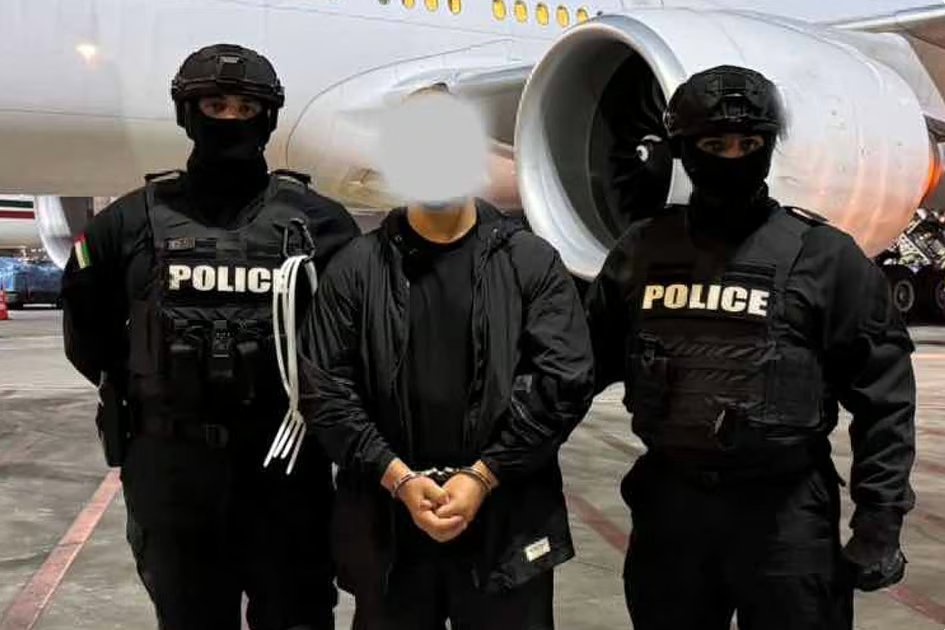
Detection is only the beginning. Once a suspicious case was flagged, the Financial Crime Unit moved in. Investigators dug deep into the background of the people and companies involved.
They examined:
⦁ Ownership records to check if a company was a “shell” created only to move money.
⦁ Bank statements to map the flow of funds.
⦁ Customs and trade records to see if declared imports and exports matched the financial transactions.
Often, what appeared to be a single suspicious transfer revealed a network of fake companies, front businesses, and international accounts designed to hide the money trail.
This stage required patience and precision. One wrong assumption could collapse a case, so investigators built detailed financial maps showing how every dirham moved from one entity to another.
International Cooperation:
Money laundering is rarely confined within one country’s borders. Criminals know this, so they move money through multiple jurisdictions—sometimes using three or four countries in a single scheme.
To counter this, Dubai Police leaned heavily on international cooperation. Between 2022 and 2024, they exchanged over 1,700 case files with agencies such as:
⦁ INTERPOL and Europol for cross-border intelligence.
⦁ Regional and Gulf law enforcement networks to track funds moving across the Middle East.
⦁ Partner countries that signed Memoranda of Understanding (MoUs) with the UAE, allowing faster information sharing.
This network meant that if laundered money left Dubai for Europe or Asia, Dubai Police could still follow the trail. The old image of money “disappearing overseas” no longer applied.
Following the Virtual Trail:
One of the fastest-growing laundering methods is through cryptocurrencies. Criminals assume that digital wallets and blockchain networks are anonymous. But Dubai Police proved otherwise.
Using advanced blockchain analytics, investigators traced funds across wallets, exchanges, and even into decentralized finance (DeFi) platforms. Over the three years, they uncovered AED 60 million worth of dirty money hidden in cryptocurrencies.
This was a landmark achievement because crypto laundering is among the hardest to track. By showing they could crack it, Dubai Police sent a powerful message to cybercriminals: the digital space is not a safe haven.
Training and Building Expertise:
Money laundering cases are notoriously complex. They require knowledge not only of policing but also of finance, law, international trade, and now digital assets. To meet this challenge, Dubai Police invested in training and human capital development.
In partnership with the United Nations Office on Drugs and Crime (UNODC), they launched a specialized International Diploma in Anti-Money Laundering and Terrorist Financing.
By 2024, over 100 professionals from Dubai Police, public prosecution, customs, and regulatory authorities had completed the program. This created a specialized workforce of financial crime experts—people capable of handling everything from traditional bank fraud to crypto laundering.
Freezing Assets and Coordinated Prosecution:
Once enough evidence was gathered, Dubai Police acted swiftly. Working with the Public Prosecution and UAE courts, they froze suspect accounts to prevent criminals from shifting funds elsewhere.
This “freeze first, investigate further” approach was effective. It stopped money from vanishing mid-investigation, a common problem in financial crime cases.
From there, prosecutors built airtight legal cases with the support of police evidence. Cooperation with the Central Bank, Ministry of Economy, and Customs ensured that suspects could not exploit regulatory gaps.
The result: many criminals not only lost their access to illicit funds but also faced prosecution, asset seizures, and prison terms.
Strengthening the System:
Beyond individual cases, Dubai Police worked to make the entire financial ecosystem stronger. They developed a unified operational framework linking multiple agencies—police, financial intelligence units, customs, and prosecutors—under a single strategy.
They also promoted public-private partnerships, encouraging businesses and financial institutions to play a proactive role in reporting suspicious activity.
By combining technology, law enforcement, and regulation, Dubai built a system where laundering became much harder to attempt in the first place.
Why This Crackdown Matters:
The significance of this three-year crackdown goes beyond statistics. Here’s why it’s important:
⦁ Protecting Dubai’s Reputation
As a global financial and business hub, Dubai thrives on trust. Money laundering could damage that trust and scare away legitimate investors. By cracking down, Dubai protects its global standing.
⦁ Meeting Global Standards
International organizations like the Financial Action Task Force (FATF) demand strong anti-laundering measures. Dubai’s efforts demonstrate compliance and help the UAE avoid being “grey-listed.”
⦁ Deterring Criminals
By proving that laundering cases can and will be uncovered, Dubai Police raise the risks for criminals. The message is clear: Dubai is not an easy place to hide dirty money.
⦁ Adapting to New Threats
The inclusion of cryptocurrency cases shows that Dubai Police are keeping pace with evolving crime trends. They are not just fighting yesterday’s battles but preparing for tomorrow’s.
Challenges Ahead:
Despite the successes, challenges remain. Criminal networks are creative, always seeking new loopholes. Some of the toughest hurdles include:
⦁ Shell companies in foreign jurisdictions that resist information sharing.
⦁ New crypto technologies like privacy coins that make tracing harder.
⦁ Balancing enforcement with business freedom, ensuring that AML rules don’t become too burdensome for legitimate businesses.
Dubai will need to keep innovating—investing in AI, expanding international partnerships, and training more specialists—to stay ahead of these threats.
Conclusion:
From 2022 to 2024, Dubai Police didn’t just solve 500 money laundering cases. They built a comprehensive defense system against financial crime.
By combining detection technology, intelligence sharing, international cooperation, specialized training, and decisive enforcement, they blocked over AED 4 billion of dirty money from entering the legal economy.
This achievement protects Dubai’s reputation, strengthens investor confidence, and sets a regional benchmark in financial crime enforcement.
Most importantly, it proves that in the modern world, fighting money laundering is not only about chasing criminals—it’s about building systems, skills, and partnerships that make crime harder to commit in the first place.